
Revolutionizing Teaching: Custom GPTs in the Educator's Toolkit
The integration of custom Generative Pre-trained Transformers (GPTs) into the educational landscape is ushering in a new era for educators and teachers. How, you ask? Let's dive in...What are Custom G...

The integration of custom Generative Pre-trained Transformers (GPTs) into the educational landscape is ushering in a new era for educators and teachers. How, you ask? Let's dive in...
What are Custom GPTs?
Custom GPTs are a form of artificial intelligence, tailored to specific domains or applications. Unlike general AI models, custom GPTs are fine-tuned to understand and respond to the unique needs and contexts of their designated fields. As such, they can be designed to address specific challenges and needs within the education sector. These AI systems can be fine-tuned to understand educational content, pedagogical methods, and student-teacher interactions, providing a level of customization that is pivotal for educational applications. In the realm of edtech, where these GPTs can comprehend educational content, pedagogical methods, and student interactions, they can become an invaluable asset for both learners and educators.
Empowering Educators
Enhancing Lesson Planning and Delivery
Custom GPTs offer teachers advanced tools for lesson planning. They can generate creative content, suggest new teaching strategies, and provide resources tailored to the curriculum. This AI assistance allows educators to craft more engaging and effective lesson plans, saving time and enhancing the learning experience.
Personalized Student Support
With custom GPTs, teachers can offer more personalized support to each student. These AI models can help identify individual learning styles and needs, enabling educators to tailor their teaching approach. This not only improves student outcomes but also ensures that no student is left behind in the learning process.
Efficient Classroom Management
Custom GPTs can assist in classroom management by automating routine tasks, such as grading and attendance tracking. This frees up teachers to focus more on interactive and enriching classroom activities, fostering a more dynamic and engaging learning environment.
Professional Development
Custom GPTs can serve as a resource for continuous professional development. Teachers can access up-to-date educational research, best practices, and innovative teaching methods, facilitated by AI-driven recommendations and summaries.
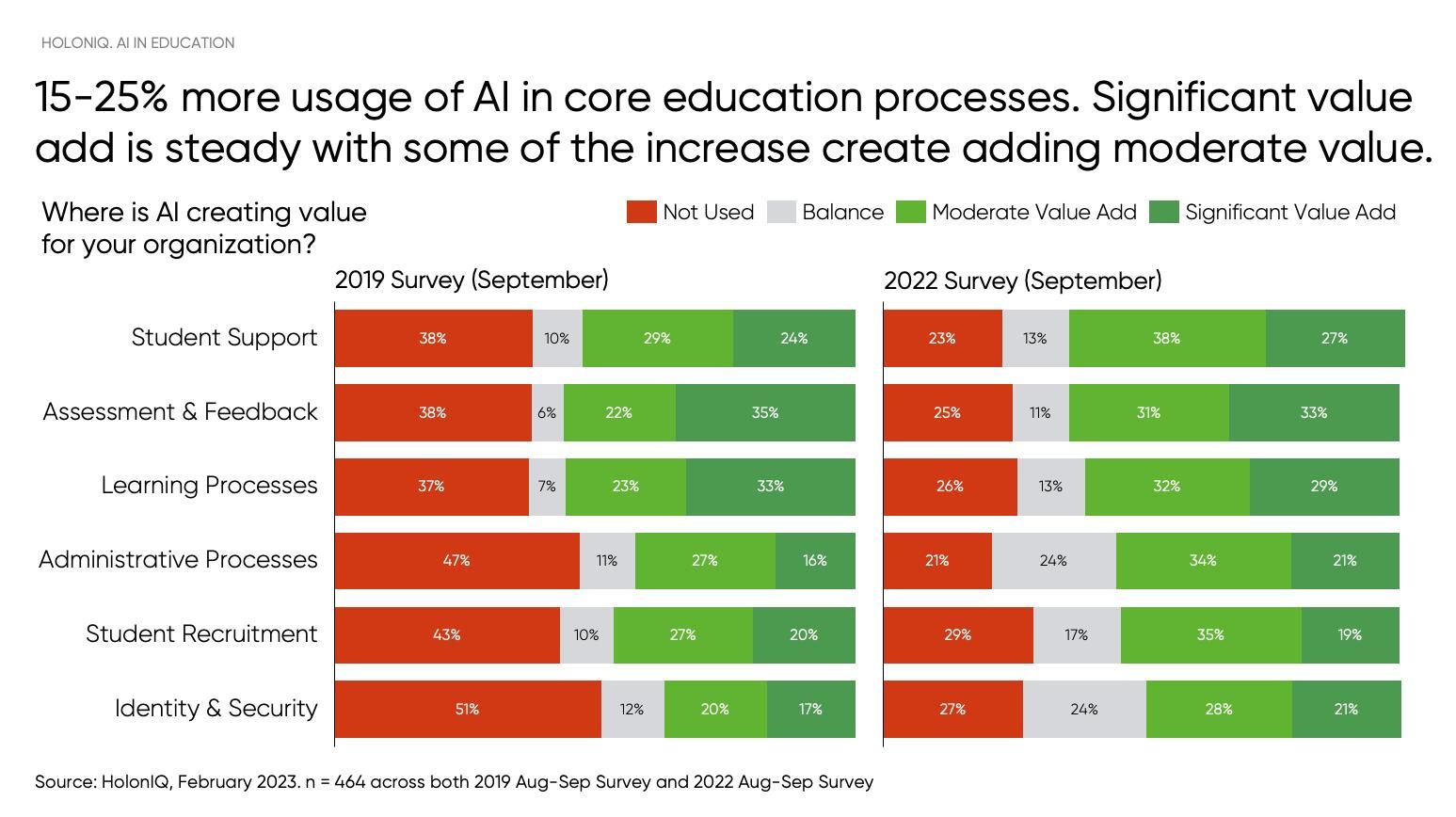
The chart shows the growing use of AI in core education processes from 2019 to 2022. It indicates that AI is increasingly being incorporated into short to medium term plans, with 44% of respondents including it in their strategies. The areas where AI is creating value in education include student support, assessment and feedback, learning processes, administrative processes, student recruitment, and identity and security. However, there is a decrease in the perceived availability of talent and skill sets to support AI work, dropping from 37% in 2019 to 28% in 2022.
Collaborative Learning and Peer Interaction
These AI models can facilitate collaborative learning experiences by suggesting group activities and projects based on student abilities and interests. They can also promote peer-to-peer interaction, enhancing the social aspect of learning which is crucial for student development.
Bridging Gaps in Education
Custom GPTs seamlessly integrate into existing educational frameworks, bridging the gap between traditional teaching methods and modern AI-enhanced approaches. This integration ensures that educators can easily adopt and benefit from AI technology without disrupting their established teaching practices.
Conclusion
Custom GPTs are not just tools for efficiency; they are partners in the educational journey, enhancing the capabilities of educators and enriching the learning experience for students. As the AI industry continues to progress at breakneck speeds, the the impact on the world of education will only continue to increase - and as educators, we must be ready.